
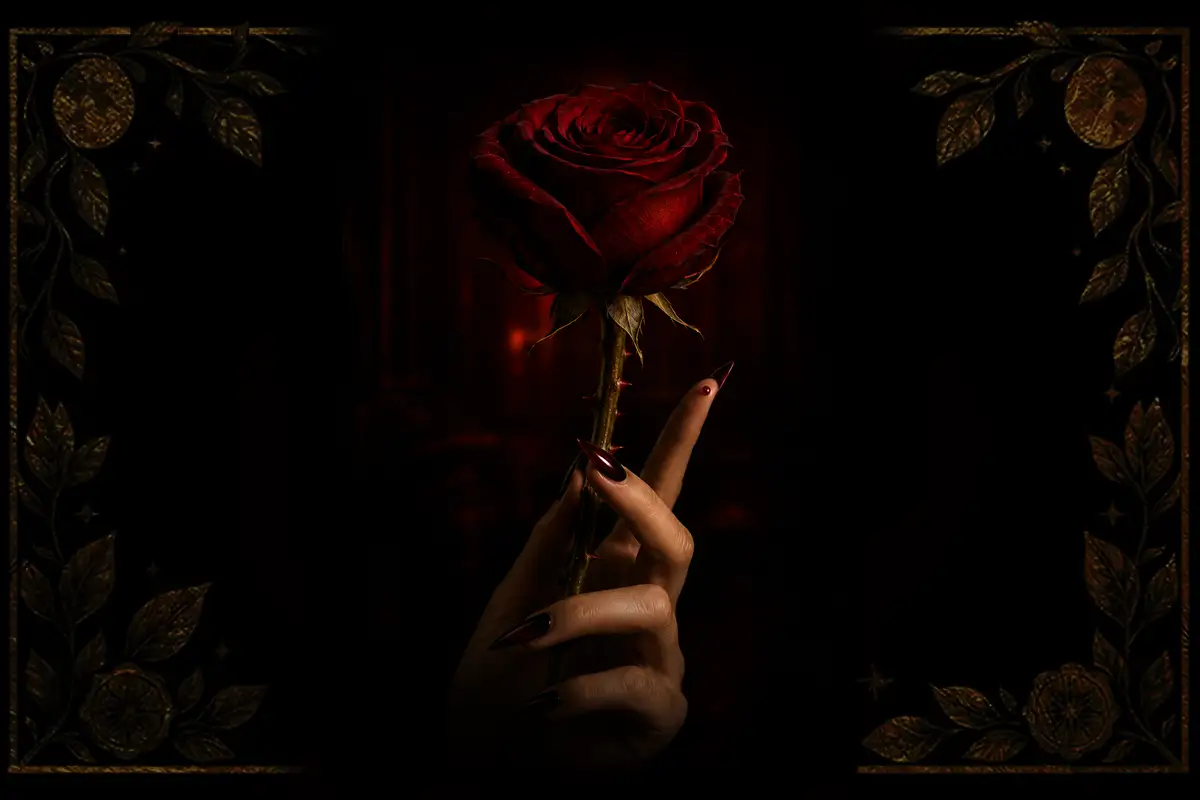
There are flowers cultivated for the table and flowers left growing against the wall.
The first arrive washed, trimmed, and persuaded into symmetry. Their stems are cut at an angle. Their leaves are removed below the waterline. They lean toward one another beneath candlelight as though they have always agreed.
The others keep their weather.
They carry rain in the folds of their petals. Beetles have slept inside them. Their stems bend where the wind taught them to bend, and their thorns remain exactly where the gardener found them.
One kind is easier to arrange.
This has often been mistaken for virtue.
The rose has suffered more interpretation than most living things. Lovers have made it obedient. Priests have made it pure. Poets have made it blush on command. By the time it reaches the painted window, it has become almost entirely symbolic and hardly botanical at all.
No soil.
No insects.
No blood drawn from the thumb.
Only the blossom, suspended in colored glass, behaving beautifully.
The thorn rarely makes it into the window.
It complicates the light.
There are, of course, practical reasons for removing it. Practical reasons have always enjoyed excellent tailoring. They arrive with clean cuffs, polished shoes, and a quiet concern for everyone’s safety.
The stem is scraped smooth.
The flower is praised.
The arrangement is called natural.
Somewhere outside, another rose leans over the garden wall.
It has not heard the sermon.
There is a particular hour in late summer when roses smell almost indecent. The day’s heat remains trapped in the petals, and the sweetness has begun to darken at the edges. Fruit, spice, damp earth, something faintly metallic.
The fragrance is no longer decorative.
It has become information.
This is the moment florists avoid and perfumers wait for.
A perfect rose says very little.
A rose beginning to turn has acquired a vocabulary.
It speaks of heat, handling, insects, rain, and the brief interval between ripeness and collapse. It has lived long enough to become difficult to summarize.
Naturally, people prefer the simpler version.
The simpler version can be embroidered onto a handkerchief. It can be placed beside a name in a family Bible. It can stand for modesty, obedience, devotion, or whatever quality is currently being requested from someone else.
The living flower is less cooperative.
It opens when conditions suit it. It closes in bad weather. It climbs. It spreads. It competes for light. It grows toward the sun without consulting the architecture. When touched carelessly, it leaves a small red correction.
Nothing dramatic.
Just enough to improve the memory.
One might imagine the thorn as the flower’s flaw. A failure of softness. An unfortunate remnant from a rougher age.
That would be a comforting interpretation.
Another possibility is that the thorn belongs there.
Not as punishment.
Not as warning.
Simply as structure.
Botanists have supplied practical explanations for this habit. Protection. Climbing support. Evolutionary advantage. All perfectly reasonable.
There are other disciplines in which the same structure would be described less generously.
Resistance, for example.
Defiance.
A difficult disposition.
The vocabulary depends largely upon who has reached for the stem.
The rose does not divide itself into the beautiful part and the difficult part. That division occurs later, usually in rooms where the windows do not open.
There, the blossom is discussed at length.
Its color is admired. Its fragrance is approved. Its placement is decided.
The stem is held beneath the table.
Anyone familiar with old records will recognize the arrangement.
In one seventeenth-century household account, a climbing rose is described as having become unruly after crossing the garden wall. The owner ordered it cut back.
No complaint from the neighboring garden survives.
The word unruly remains.
One finds this often in old records.
The subject is lost.
The judgment is preserved.
The language changes, but the vase remains.
A person may be praised for grace until grace becomes influence. Admired for beauty until beauty begins choosing where to look. Valued for intelligence until intelligence reaches an unauthorized conclusion.
Then someone notices the thorns.
They are seldom newly grown.
Only newly inconvenient.
Some accusations are only boundaries, rewritten by whoever was standing too close to them.
The record will describe what happened next with admirable restraint.
A concern was raised.
A character was questioned.
A pattern was observed.
The flower, once praised for its bloom, is suddenly found to have been dangerous all along.
This is how gardens become evidence.
It is also how evidence becomes perfume.
A natural rose material does not smell like the idea of a rose. It shifts between lemon peel, honey, green stem, wax, pepper, damp soil, and warm skin. One moment it is velvet. The next, something sharper appears beneath it.
At this point the perfumer has a choice.
Polish the rose back into romance.
Or allow it to continue speaking.
The second method produces less obedient results.
People who expect romance may find botany instead.
People who expect innocence may find appetite.
People who know what they are smelling will not be surprised.
The rose was never confused.
Only edited.
Perhaps that is why it appears so often at weddings and funerals. It is useful at thresholds, where one condition becomes another and polite language begins to fail.
A rose placed on a grave says love.
It also says the body is below.
A rose offered across a table says desire.
It also says the hand may bleed.
Both statements are true.
This makes the flower unsuitable for simple people and irresistible to everyone else.
So the old question remains.
Blossom or thorn?
It sounds like a choice offered by someone holding the shears.
The rose, meanwhile, continues over the wall.