
Blackwood - Devotion
Dark Academia Gothic Romance - Chapter 1: The Gates of Saint Jude’s
Chapter 1 : The Gates of Saint Jude’s
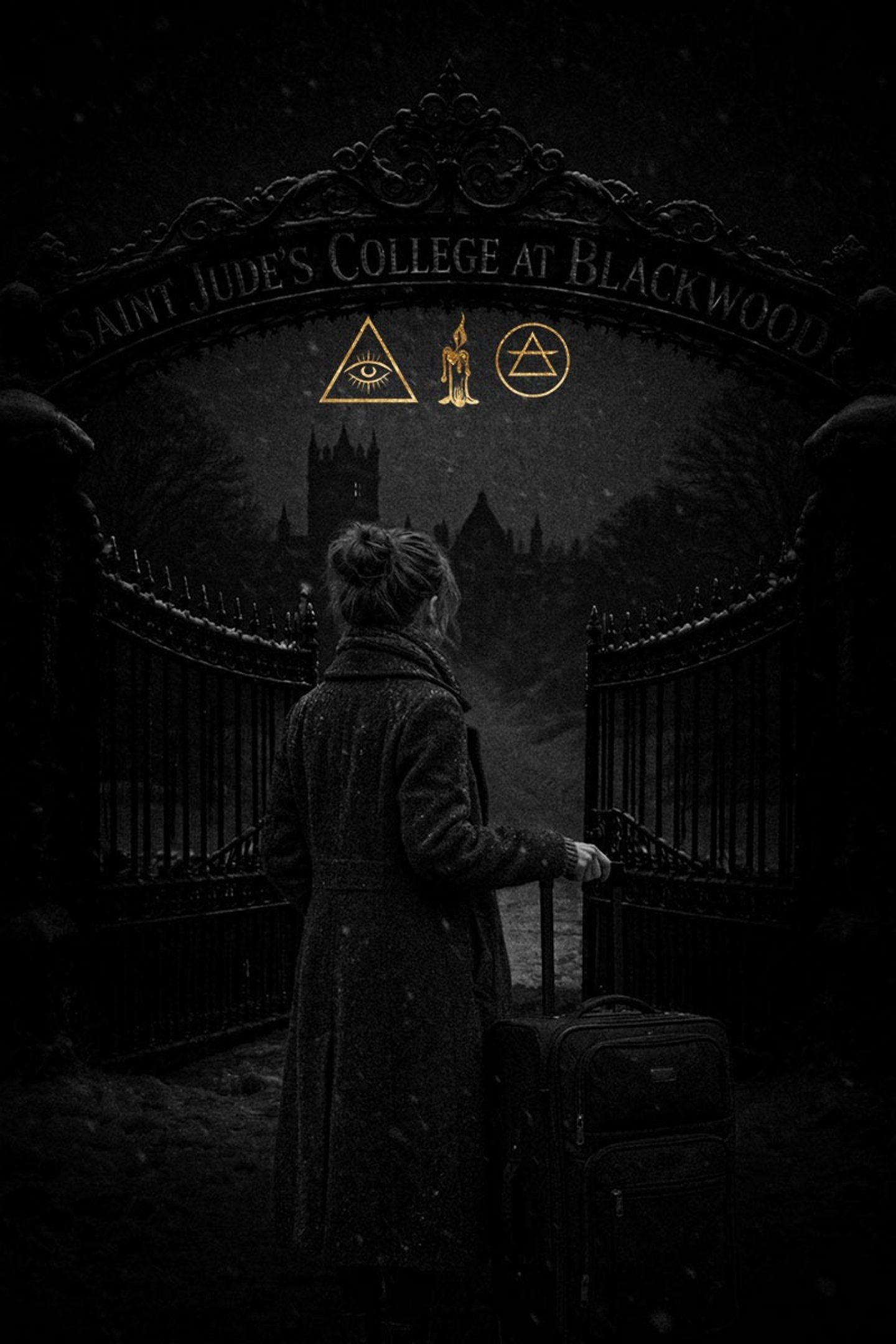
No one from Saint Jude’s came to meet me at the gates. By the time I realized why, it was too late to leave.
The Uber slowed, tires crunching uncertainly over packed snow, then stopped altogether.
“I’m sorry,” the driver said, peering through the windshield at the dark incline ahead. “Road’s not plowed. I’m not taking this up there.”
Beyond the gates, the campus drive disappeared into drifting white and shadow.
He popped the trunk. Cold air flooded in immediately, sharp enough to sting the inside of my nose.
“It’s not far,” I said, though I had no real idea if that was true.
“It’s far enough if I get stuck,” he replied, not unkindly.
My suitcase hit the ground with a dull thud. By the time I pulled the handle upright, he was already back in the car.
The headlights swung across the iron arch, catching frost-silvered letters before turning away.
Then the car was gone, swallowed by the trees as if it had never been there at all.
The silence that followed felt immediate and personal.
Behind me, the wrought-iron gates shifted in the wind and swung shut with a soft, decisive click.
For a moment I just stared at them, half expecting they might lock themselves.
When I pushed, the metal gave easily, the latch lifting with a small, ordinary sound that felt almost disappointing after the drama of their closing.
SAINT JUDE’S COLLEGE AT BLACKWOOD curved across the arch in looping ironwork, each letter rimmed with frost. Ivy clung to the stone pillars on either side, blackened and stiff with winter, as if even the plants here were reluctant to let go.
I had imagined this moment for months. Years, if I was being honest. Standing at the threshold of a place I had only ever seen in glossy brochures and carefully curated website photos, all sunlit courtyards and earnest students reading beneath ancient trees.
None of those photos had shown the gates at night.
None of them had shown how the campus road disappeared into darkness so complete it felt architectural, like a wall built of shadow instead of stone.
My phone buzzed in my pocket, startling me. A notification from the ride app: Your trip has ended. Rate your driver.
Five stars, I thought numbly. He had delivered me exactly where I had asked to go. Whether I could survive the location afterward did not seem to be part of the contract.
The cold was already working its way through my coat, thin, precise fingers slipping past wool and down into the seams of my clothes. Maine cold was different from the kind I had grown up with, not just lower on the thermometer but sharper, as if it had edges.
I pulled my suitcase forward. The wheels crunched over salt and frozen gravel, loud in the quiet.
The path curved uphill between towering trees, their trunks pale where snow clung to the bark. Lamps appeared at intervals, old-fashioned things with frosted glass panes that gave off a dim amber glow. They did not so much illuminate the road as suggest it, each one creating a small island of visibility surrounded by darkness.
By the third lamp, my fingers had gone stiff around the handle.
By the fifth, I was aware of how completely alone I was.
No other luggage tracks marked the snow. No voices carried through the air. No light showed in the windows of the distant buildings rising ahead, slate roofs and sharp gables cutting into the low sky like broken teeth.
It felt less like arriving at a college and more like trespassing into something that had not been informed of my existence.
I told myself that was ridiculous. Orientation did not start until tomorrow. Of course the campus would be quiet. Of course most students had not returned yet.
Still, the silence seemed to lean closer as I walked, attentive in a way silence should not be.
When the main building finally came into view, I stopped without meaning to.
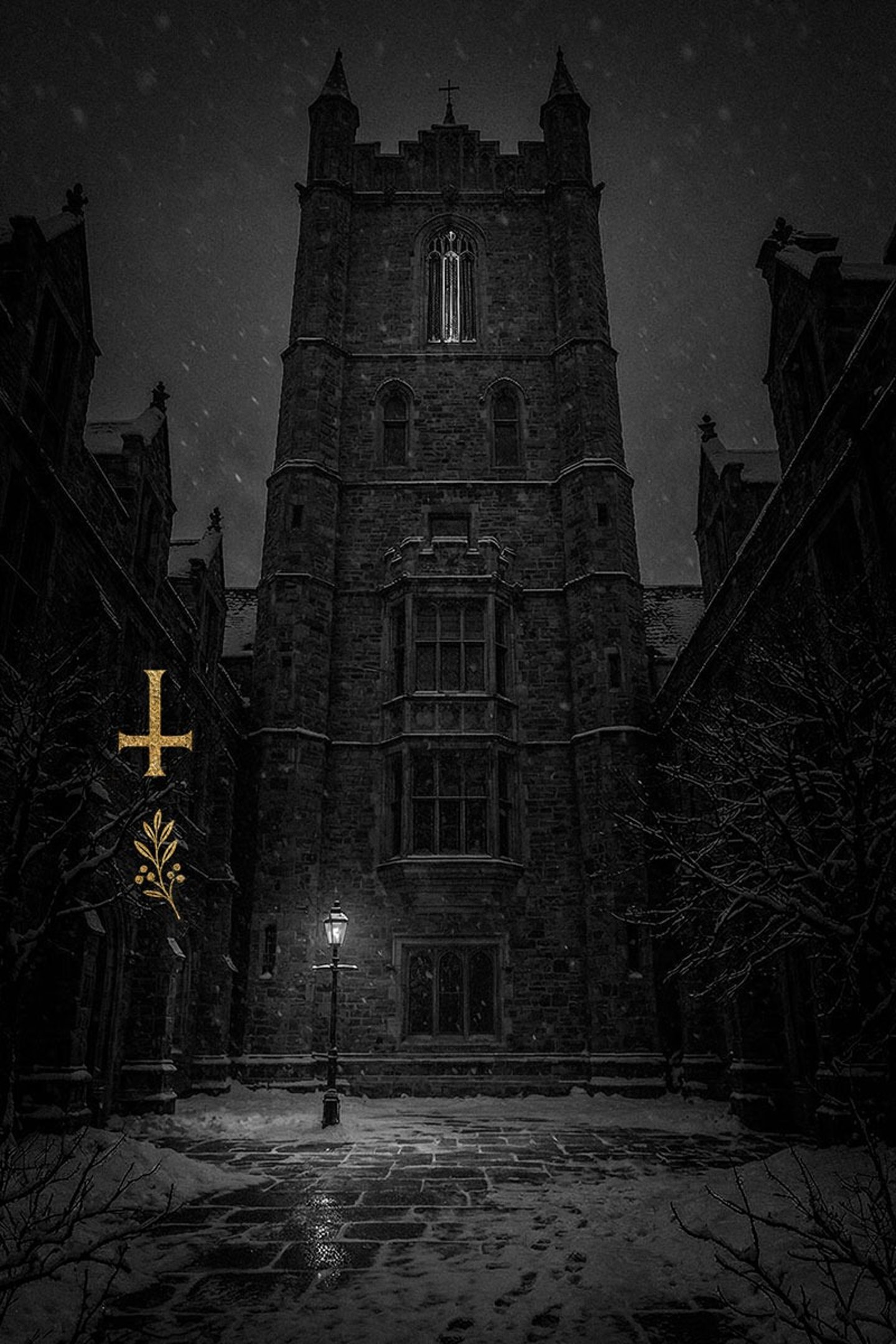
It was larger than any photograph had suggested, a vast structure of dark stone and narrow windows, its facade patterned with buttresses and arches that belonged more to a cathedral than an academic institution. Snow had gathered along every ledge and decorative flourish, softening the edges but also making the whole thing look abandoned, as if it had been empty for decades and the weather had been slowly reclaiming it.
Only one window was lit.
High up, near the corner tower. A single square of warm yellow light in an otherwise black wall.
I squinted, trying to make out movement behind the glass, but the distance was too great. It might have been an office. A late-working professor. A maintenance crew.
Or someone watching the drive.
The thought arrived fully formed and refused to leave.
I started walking again, faster now, the suitcase rattling in protest. The steps leading to the main entrance were wide and shallow, worn slightly concave in the center as if generations of students had carved their presence into the stone simply by passing over it.
Halfway up, I paused to catch my breath.
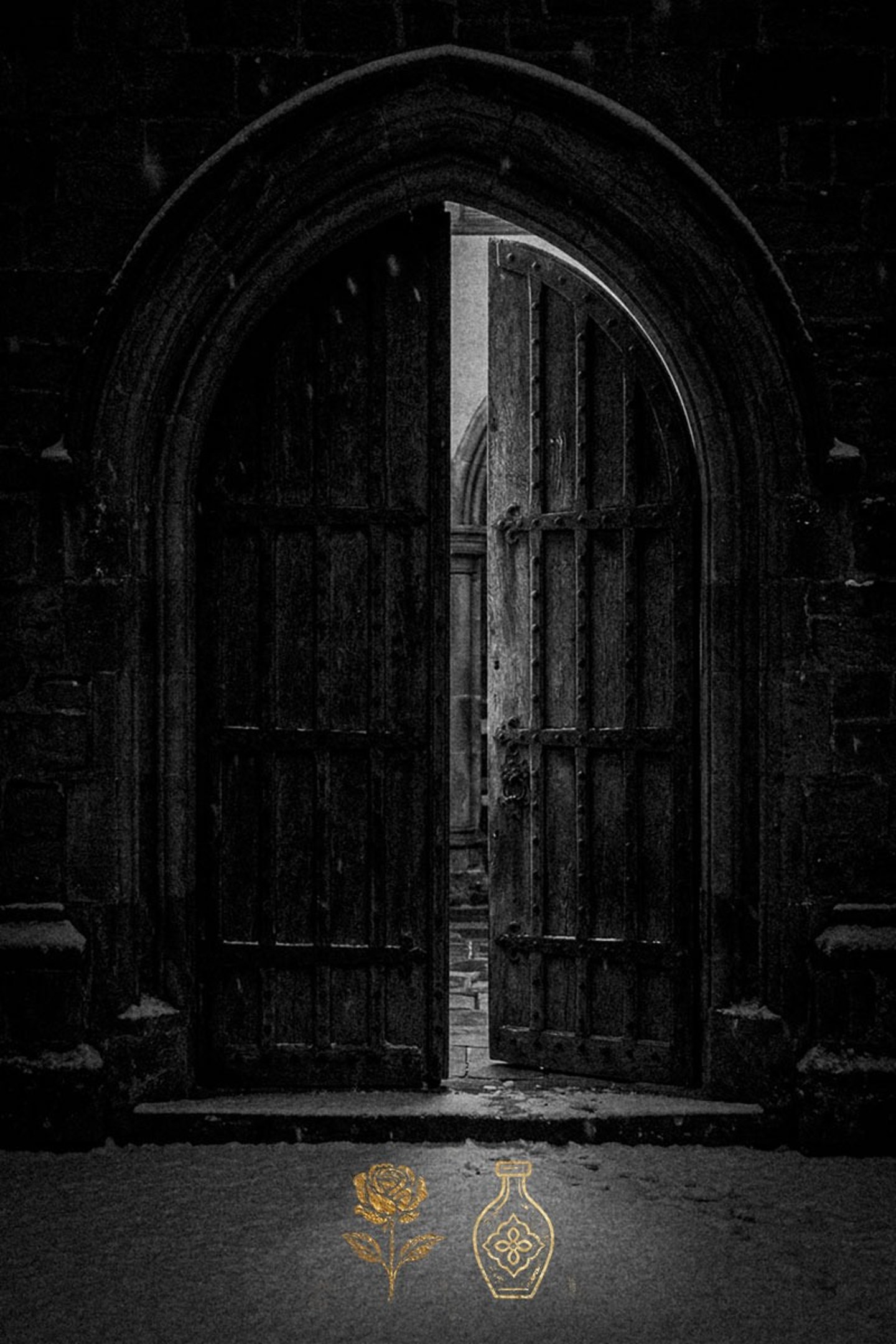
The doors were massive, dark wood banded with iron, polished by use to a dull sheen. One stood slightly ajar, a wedge of light spilling onto the snow. I hesitated at the threshold, suddenly aware of my reflection in the glass panel set into the upper half.
Pale face. Wind-reddened nose. Snow caught in my hair like ash. For a moment I looked less like a new student and more like someone who had wandered out of the woods by mistake.
Or been sent.
“Don’t be dramatic,” I muttered under my breath, though there was no one there to hear it.
I pushed the door open.
Warm air rushed over me, thick with the smell of old wood and something faintly medicinal, like polish or dried herbs. The entry hall stretched upward for three stories, ribbed vaulting crossing the ceiling in pale stone arcs. A chandelier hung in the center, its bulbs shaped like candle flames, casting a soft, uneven light that left the corners in shadow.
My footsteps echoed. Not loudly, but enough that I felt compelled to walk more quietly, as if noise might carry to places I could not see.
Portraits lined the walls, stern faces in dark clothing, men and women painted in styles that spanned centuries but shared the same watchful stillness. Their eyes followed the path toward the central staircase, a broad sweep of marble worn to a dull shine.
At the base of the stairs stood a girl.
She had not been there a second ago. I was almost certain of it.
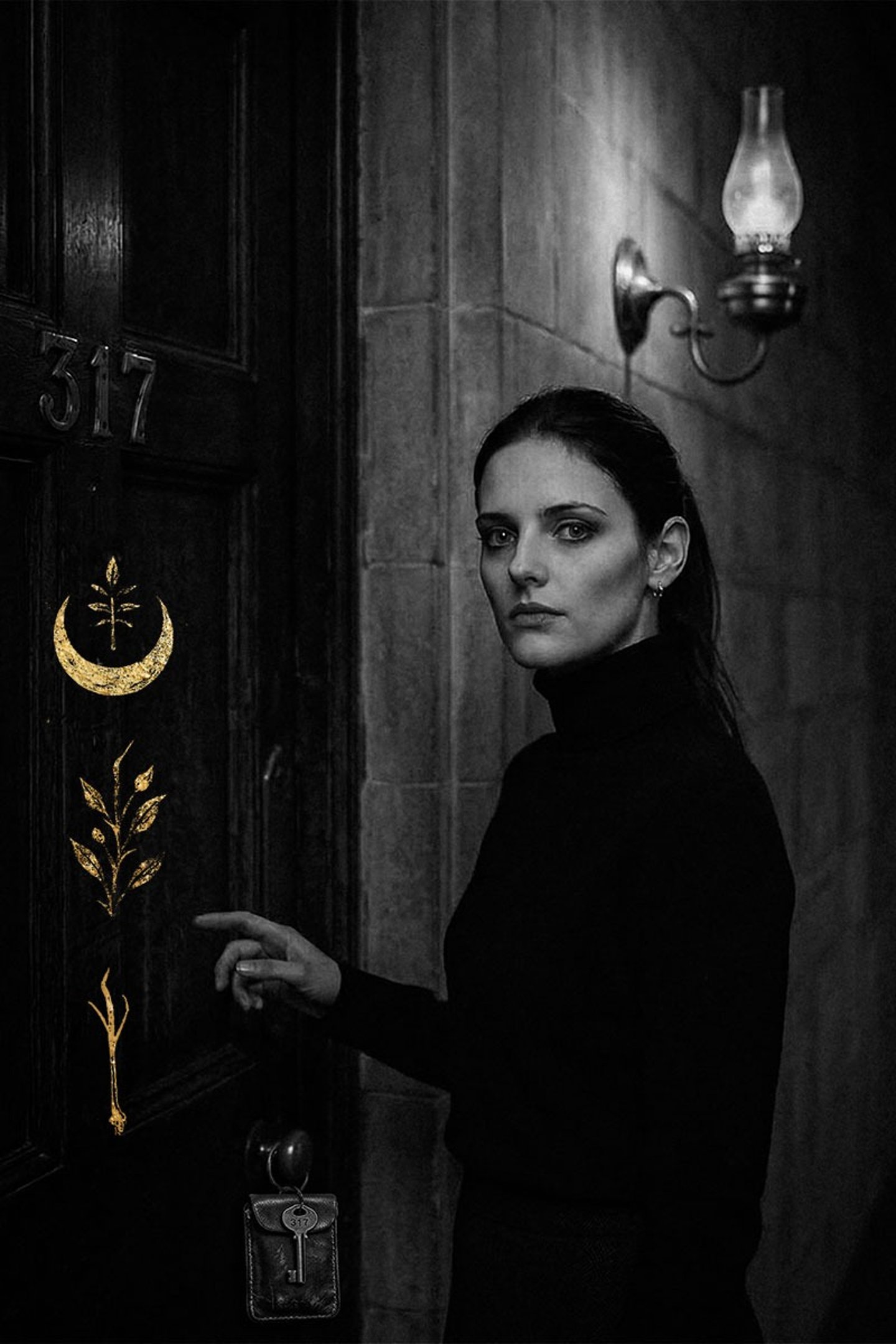
On the third floor, she stopped outside a heavy wooden door marked 317 in tarnished brass.
“This one,” she said.
She waited while I fumbled with the key packet hanging from the knob, the leather pouch stiff with cold. The lock turned with a reluctant click, the door opening onto a room washed in dim lamplight from a single desktop fixture.
High ceiling. Stone walls half hidden behind dark paneling. A narrow bed, a heavy desk, a fireplace laid with logs but unlit. Frost traced delicate patterns across the glass panes, turning the outside world into a blur of gray and white.
It was beautiful in a severe, unfriendly way. Like something that had never been intended to comfort anyone.
I stepped inside, setting the suitcase down with a dull thump. The air was warmer than the hallway but still carried a chill, as if the room had been heated only recently after a long period of disuse.
When I turned back, she was still standing in the doorway.
For a moment neither of us spoke.
“Thank you,” I said again, softer this time.
She considered me, expression unreadable.
“You’re welcome,” she said, though it sounded less like reassurance and more like a statement of inevitability.
As she stepped back into the hall, I found myself blurting, “Wait.”
She paused.
“I didn’t get your name.”
For the first time, something like amusement touched her mouth, subtle but unmistakable.
“Mara,” she said. “Mara Vale.”
The name settled into the room like something that had weight.
“And you are?”
“Elara. Elara Quinn.”
She repeated it once under her breath, testing the shape of it.
“Elara.”
Something about the way she said it made it feel less like a name and more like a piece of information she intended to keep.
“Sleep,” she added. “Tomorrow will be… busy.”
With that, she turned and walked away, her footsteps fading down the corridor until the silence returned, thicker than before.
I closed the door slowly, resting my forehead against the cool wood.
Mara Vale.
Outside, the wind rose, rattling faintly against the window. For a moment I thought of the single lit square high in the main building, the sense of being observed from a distance too great to confirm.
Then I noticed something I was certain had not been there before.
On the desk, beside the unlit lamp, lay a book.
Plain black cloth cover. No title.
The same one she had been carrying.
I did not remember hearing her set it down.
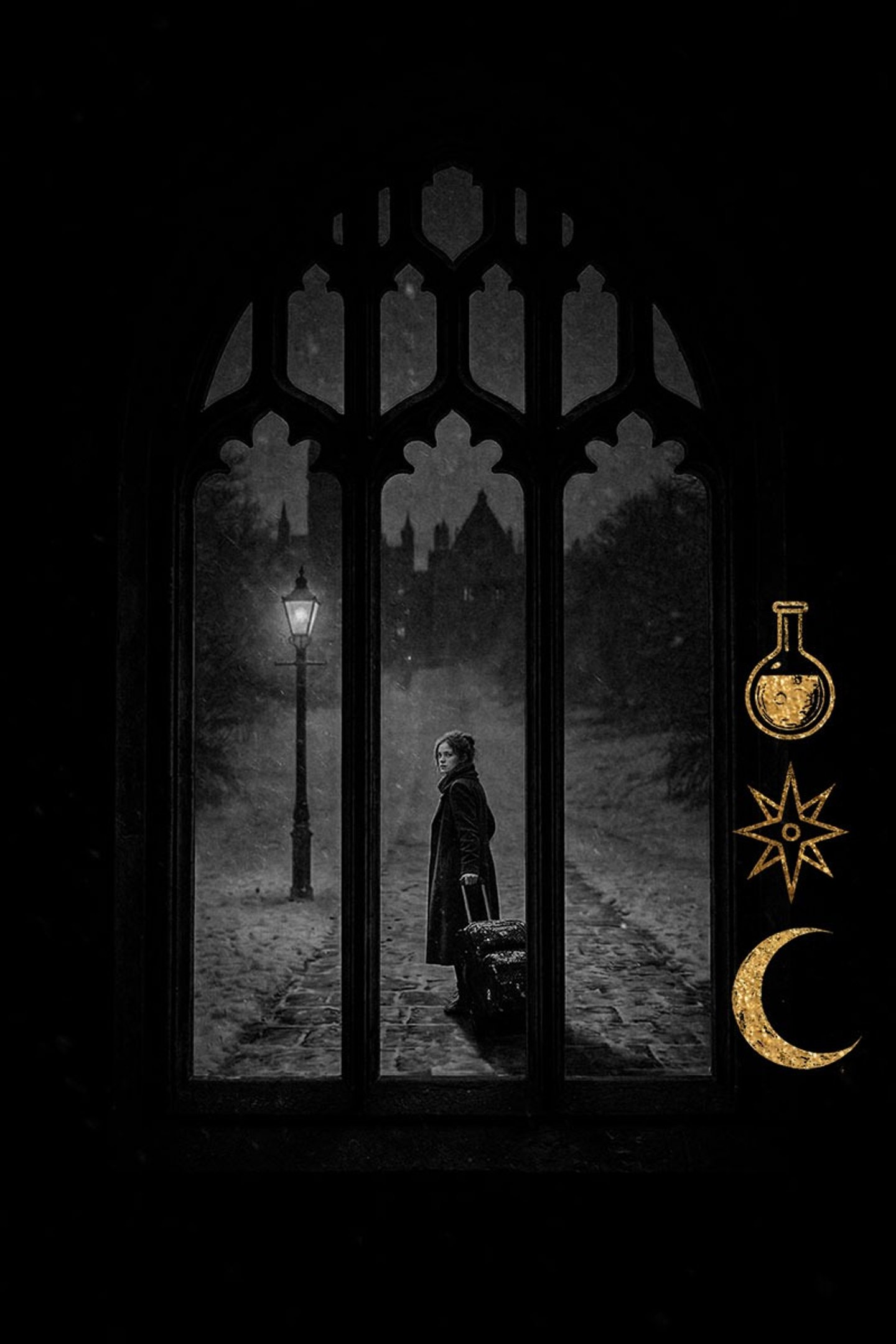
Not because I was tired. Because the air smelled different here.
Not just cold. Something older beneath it. Dry paper. Dust. A faint trace of smoke, as if fires had burned in the building for so long that the scent had seeped into the stone itself and never fully dissipated.
Library smell, my brain supplied immediately, though I had no idea why the main administrative building would smell like a library from the outside.
Unless the library was inside.
Unless everything was inside.
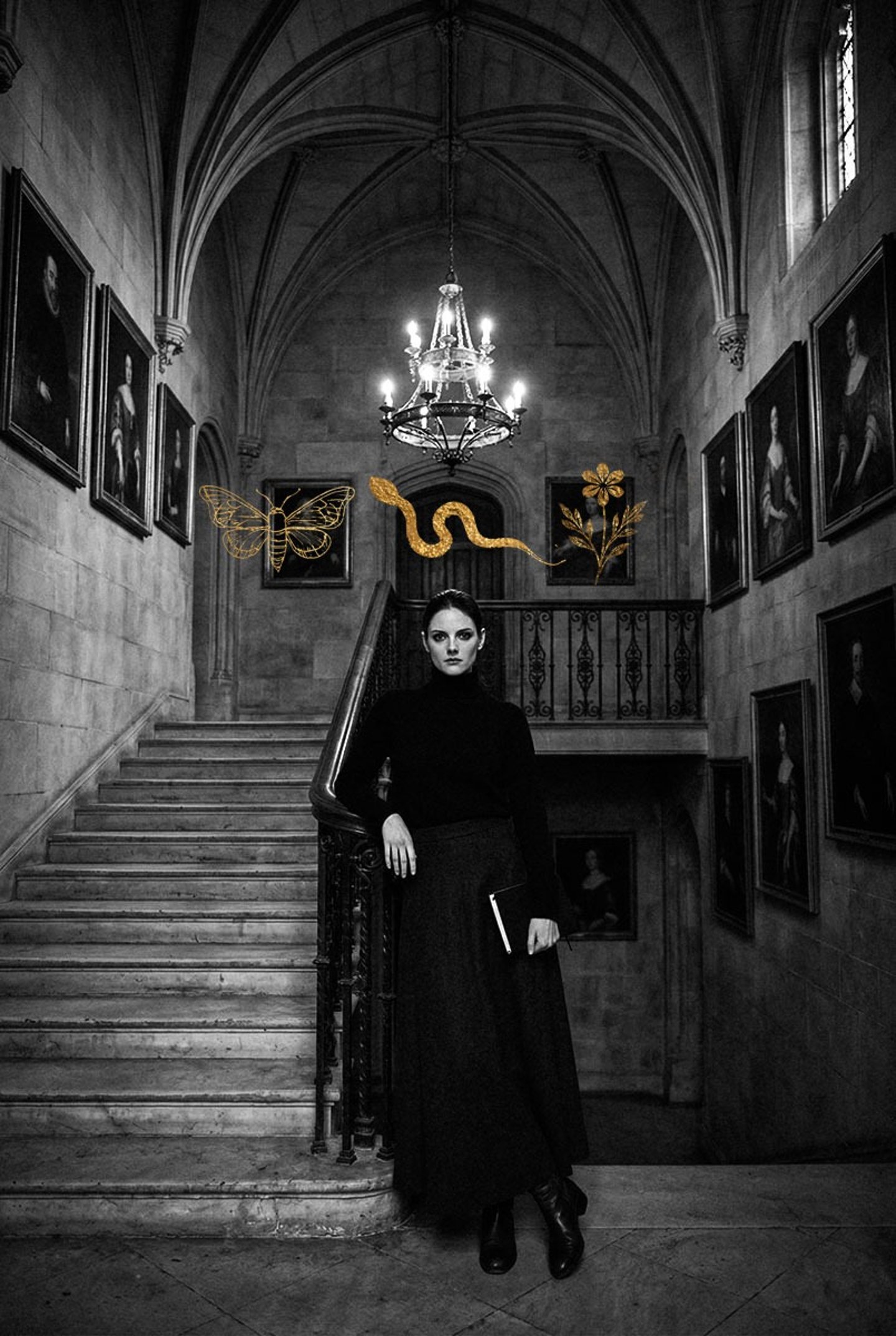
She was leaning against the banister as if she had been waiting, one ankle crossed over the other, a book tucked loosely under one arm. Her hair was dark enough to blur into the shadows behind her, cut blunt at her jaw. She wore no coat despite the draft that curled through the hall each time the door shifted on its hinges, just a black sweater and a long skirt that brushed the tops of her boots.
For a moment we simply looked at each other.
Her gaze moved over me with unhurried precision, taking in the suitcase, the damp hem of my jeans, the snow melting into dark patches on my shoulders. It was not rude exactly. It felt more like assessment, the way a professor might glance at a paper before deciding how harshly to grade it.
“You’re early,” she said at last.
Her voice was low, even, the kind of voice that did not need to be loud to carry. There was no welcome in it, but no hostility either. Just a calm statement of fact, as if my arrival time had been personally inconvenient.
“My flight got in ahead of schedule.”
She nodded once, as if that explained everything, though I could not imagine why it would matter to her at all.
“Orientation check-in is tomorrow,” she said. “Administrative offices are closed.”
“I know. I’m just looking for the dorm assignments. They said there would be someone here tonight.”
Her eyes flicked to the crumpled paper in my hand without her taking it.
“Gothic Hall,” she said. “Third floor.”
I blinked. “You don’t need to see the…”
“I don’t.”
Something in her expression suggested that continuing to question her would be a mistake, though I could not have said why. She pushed away from the banister in one fluid motion, the book shifting in her grip. Up close, I could see that the cover was unmarked, plain black cloth with no title.
“Follow me,” she said, already turning toward the stairs.
I hesitated only a fraction of a second before dragging my suitcase after her. The wheels made a dull thudding sound against the marble steps, loud enough that I winced, but she did not comment, did not even slow down. She moved with effortless familiarity, not bothering to look back, as if she had complete confidence that I would keep up.
We reached the second landing before I realized she had not introduced herself.
“Thank you,” I said, breathless more from nerves than exertion. “I really appreciate…”
She stopped so abruptly I nearly ran into her.
For the first time, she turned fully toward me. The light from the chandelier above caught in her eyes, making them appear almost colorless, a pale gray that reflected more than it revealed.
“Don’t,” she said quietly.
The word was not sharp. It was simply final.
“Don’t what?”
“Assume this is kindness.”
Something inside my chest tightened, not entirely unpleasantly. Like the moment just before stepping onto a stage, when fear and anticipation become indistinguishable.
“Then what is it?” I asked before I could stop myself.
She studied me for a long second, head tilted slightly, as if considering whether the question deserved an answer.
“Curiosity,” she said at last.
Her gaze dropped briefly to my mouth, then returned to my eyes with deliberate slowness that sent heat unexpectedly up my throat despite the lingering cold in my bones.
“You don’t look like someone who will stay uninteresting for long.”
Before I could respond, she turned again and continued up the stairs.
I followed because there was nothing else to do.
Because she was leading me somewhere warm.
Because the thought of stepping back outside into the dark suddenly felt unbearable.
Because, though I did not yet know her name, I had the unsettling sense that something important had just begun, the way a storm begins not with thunder but with the pressure in the air changing so gradually you only notice once it is too late to prepare.
If you wish to continue, Sign the book with your email address. You’ll be notified when the next chapter is available.
Cocina de Brujas
They Called it Heresy. We Call it Tuesday.
Follow us here
© 2025. All rights reserved.
Join the kindred who cross the veil to claim their power through ritual scent journeys. Be first to experience emerging magick, whispered offers, and stories that kindle the senses. Sign the Book.
We guard your information like a sacred secret. No spam. No third party sharing. Unsubscribe anytime.