

In seventeenth century England, if you believed a witch was making you ill, there was a remedy. It did not involve a priest, a court or a doctor in the modern sense. It involved a jar, a handful of nails, and something you already had about the house, which was your own urine.
This is the witch bottle. People really made them. Every so often, one still turns up.
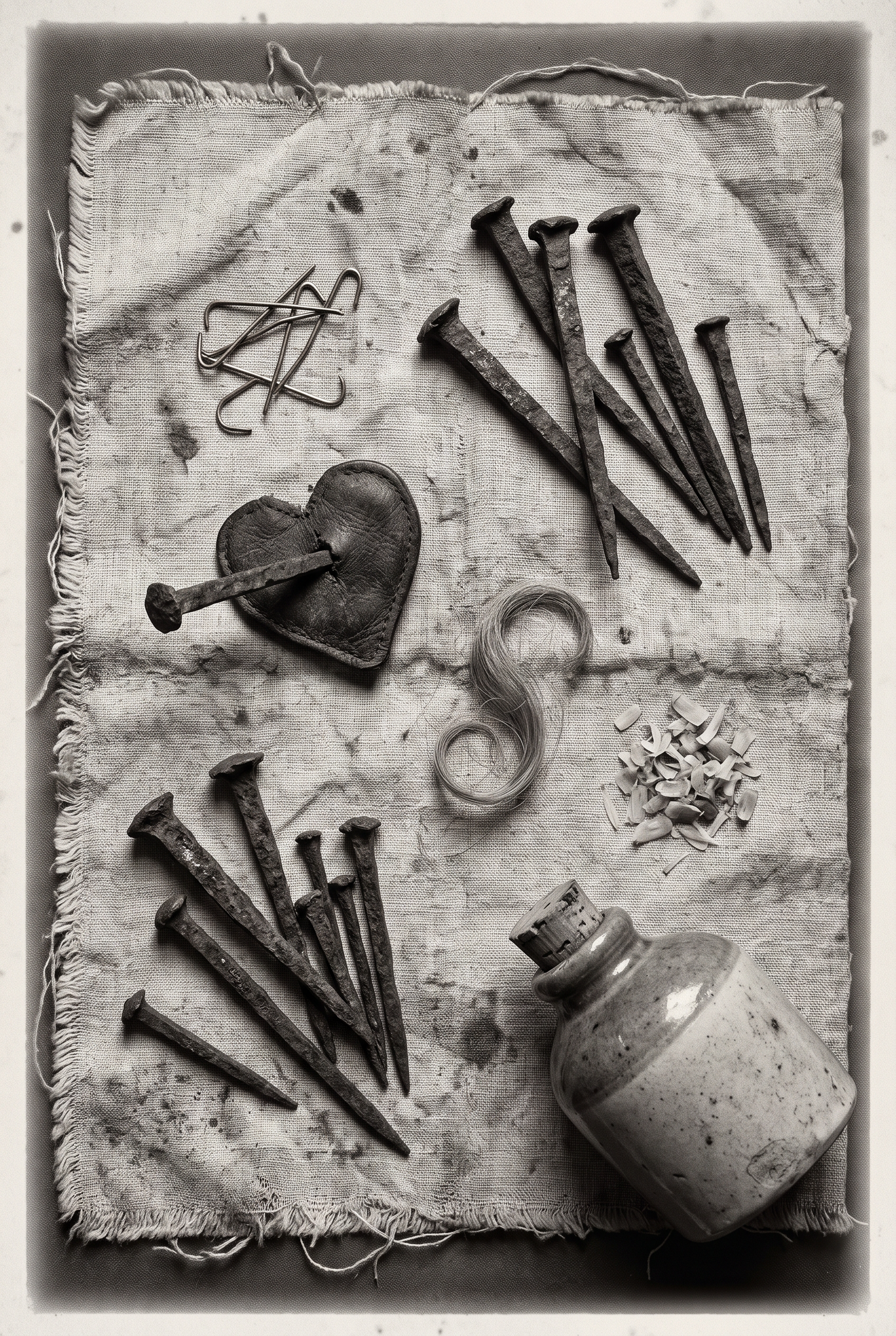
The recipe
In 1671 a Reading astrologer named Joseph Blagrave published his Astrological Practice of Physick, a book of cures that also promised to deal with harm from sorcery and witchcraft.
His instructions were short. Take the urine of the patient, stop it up in a bottle, and put into it “three nails, pins or needles, with a little white salt.” Keep it warm.
The theory was a kind of magical plumbing. A witch who cursed you was thought to be linked to you, so whatever you did to your own water, you did to hers. Blagrave reported that the witch would be “grievously tormented making their water with great difficulty, if any at all.” Leave the bottle long enough, he warned, and it might endanger the witch’s life.
The historian notes that this is the only known system of justice in which the trial, the sentence and the evidence are all kept in the same jar.
The jar with a face
The favourite container was a stoneware jug made in Frechen, in Germany, and very common in England. They are called Bartmann jugs, which is German for “bearded man,” or Bellarmines, and on the neck of the classic ones is a moulded bearded face.
The face was a decoration, not a guard. But when you needed a vessel to hold a curse, a jug that already looked cross must have seemed like the right man for the job.
The London Museum holds several of these jugs that were re-used as witch bottles. One, from the middle of the seventeenth century, still has a mass of rusted iron nails inside it. Another was found containing bent pins and, in the museum’s words, “apparently buried for magical purposes.”
The historian would like the museum to know that “apparently” is doing heroic work in that sentence.
The one that was never opened
Most witch bottles turn up broken or empty. In 2004, workers in Greenwich, in London, found one that was neither. It was a Bellarmine jar, buried upside down, and when they picked it up it rattled and sloshed.
It went to Alan Massey, a retired chemist with a long interest in witch bottles. He and his colleagues X-rayed it and found pins and nails jammed in the neck. A CT scan showed it was about half full of liquid. They drew some out through the cork with a long needle and ran it through proper laboratory instruments, which is presumably not what the instruments had in mind when they were bought.
The liquid was urine. It contained a breakdown product of nicotine, which suggests the owner smoked, and traces of sulphur, which suggests brimstone had been added for good measure.
The solid contents were these: twelve iron nails, one of them driven through a leather heart, eight brass pins, clumps of hair, ten fingernail clippings, and a small clot of what looked like navel fluff. The clippings were neatly manicured. Massey took this to mean the person was of some standing, which is the most English possible conclusion to draw about someone who has just buried a jar of their own urine.
The recipe matches the paperwork. A court record from 1682 describes an apothecary advising a husband to “take a quart of your Wive’s urine,” along with her nail parings and some of her hair, and boil it all up in a small pot.
The witch who is still inside
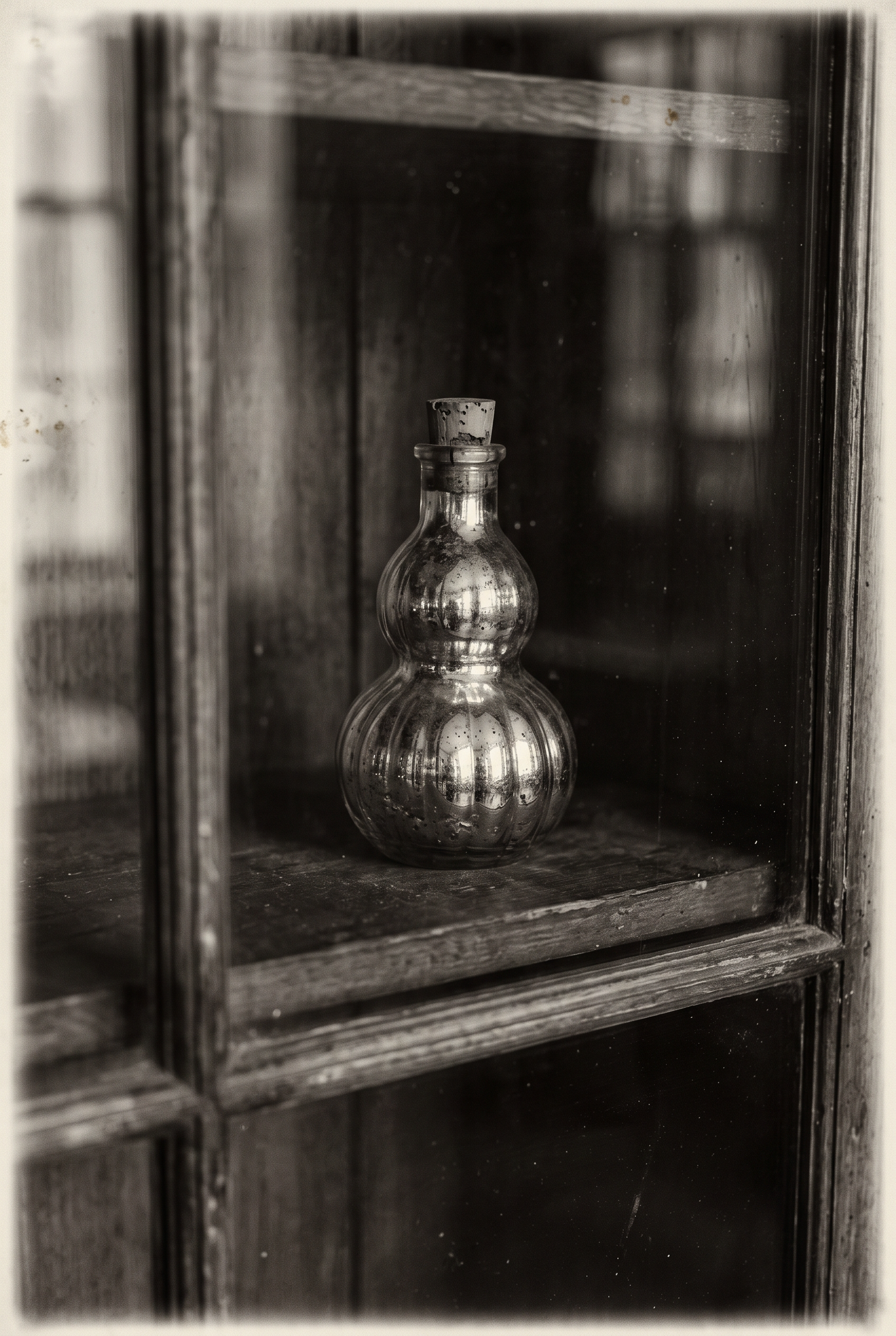
The strangest bottle of all is not a jug. It is a small ribbed glass flask, silvered on the inside and stoppered, in the Pitt Rivers Museum in Oxford. The museum’s report for 1926 lists it plainly as “said to contain a ‘witch’,” from Hove, in Sussex, presented by Miss M. A. Murray.
Margaret Murray was an Egyptologist and folklorist. She said the flask had come from an old woman near Hove, who warned her that there was a witch in it, and that if anyone let it out there would be a great deal of trouble.
The flask is still stoppered. The museum’s catalogue does not record anyone checking.
The File
The documented record behind this post:
- Joseph Blagrave, Astrological Practice of Physick, London, 1671. Recipe and quotes as given by the Museum of Witchcraft and Magic, Boscastle (object page “Bellarmine Jar with boxed contents”). Bibliographic details: Wellcome Collection catalogue.
- Bartmann (Bellarmine) stoneware jugs made in Frechen, Germany, re-used as witch bottles: a mid-17th century jug with “a mass of rusted iron nails” inside, and a jug found containing bent pins, “apparently buried for magical purposes as a witch bottle.” (London Museum collections, “Jug, Bartmann jug, witch bottle,” object 57.43 and object page 468031)
- Greenwich witch bottle, found 2004, analysed by Alan Massey: buried upside down, X-ray and CT scan, urine with a nicotine product and sulphur, 12 iron nails (one through a leather heart), 8 brass pins, hair, 10 manicured nail clippings, navel fluff. 1682 court record quoting an apothecary’s advice. (Samir S. Patel, “Opening a Witch Bottle,” Archaeology magazine, Archaeological Institute of America, 2009; first reported in British Archaeology)
- Silvered, stoppered glass flask “said to contain a ‘witch’,” Hove, Sussex, presented by Miss M. A. Murray. (Pitt Rivers Museum, Report of the Pitt Rivers Museum, 1926)
- The old woman near Hove and her warning. (Murray’s own account, as retold by the Hove history blog hovehistory.blogspot.com, which cites Malcolm Gaskill, Fortean Times, November 2018. Accounts give the year she got it as 1913 or 1915, so this post leaves it out.)
Everything above the jokes is the record. The jokes are the historian’s.
Sign the Book. Odd histories, strange finds, first word on what comes next. Sign it at cocinadebrujas.com.