
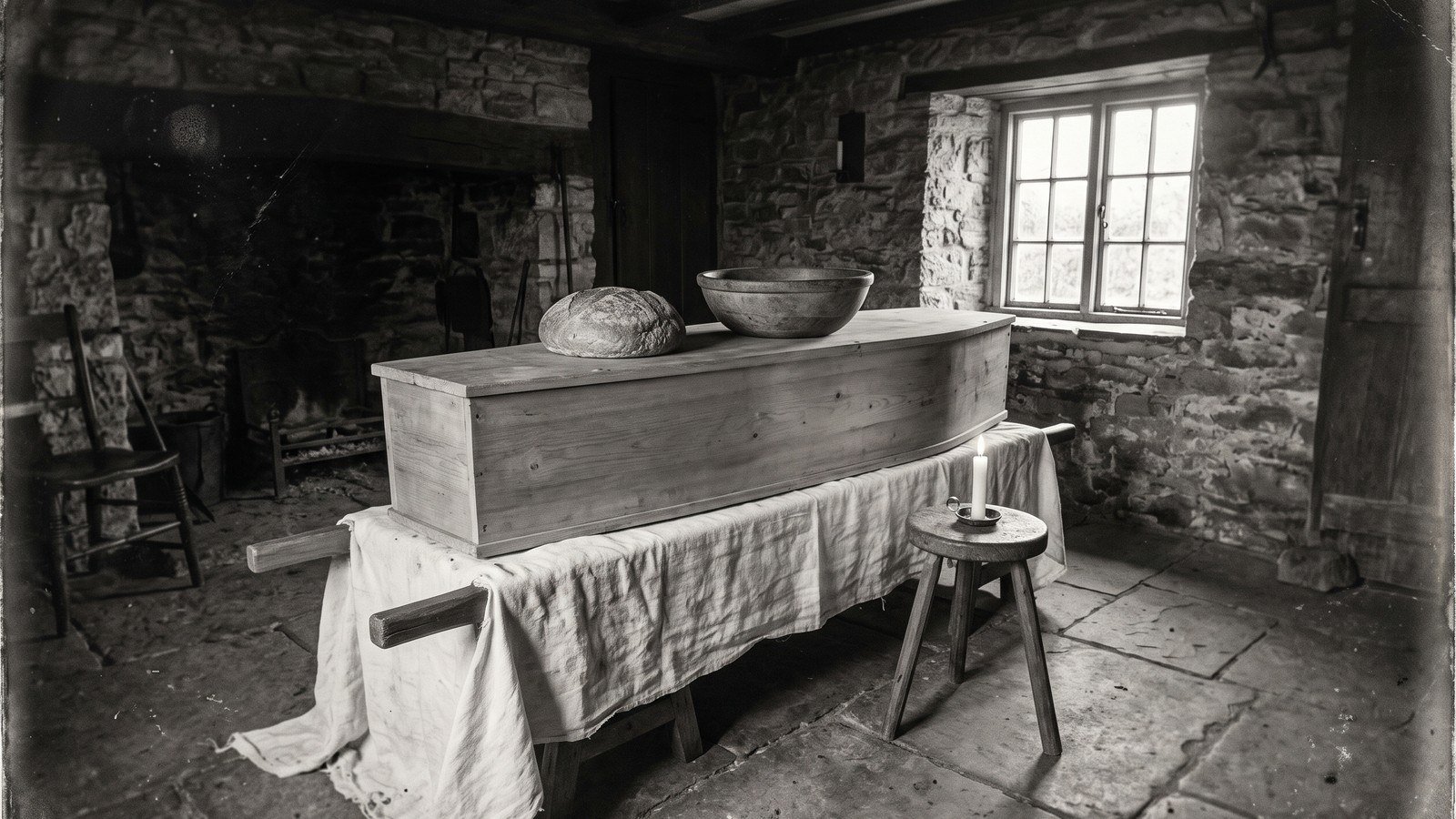
In the seventeenth century, on the border of England and Wales, dying with your sins still on you was considered a poor plan. There was a fix. It cost about sixpence, a loaf and a bowl of beer, and it was handled by the least popular man in the parish.
He was called the sin eater.
The recipe, according to John Aubrey
Almost everything we know starts with John Aubrey, the antiquary and gossip who wrote Brief Lives and could not walk past a strange custom without writing it down. In his notebook Remaines of Gentilisme and Judaisme, kept in the 1680s, he described funerals in Herefordshire.
When the body was brought out of the house and laid on the bier, “a loafe of bread was brought out and delivered to the sinne eater, over the corpse”. Then came “a mazar bowle, of maple, full of beer (which he was to drink up)”, and “sixpence in money”. By eating and drinking over the dead, the sin eater took their sins upon himself, and the dead were spared from walking after death.
That was the deal. The dead got a clean slate. The sin eater got lunch, a drink and sixpence, and kept the sins.
The man himself
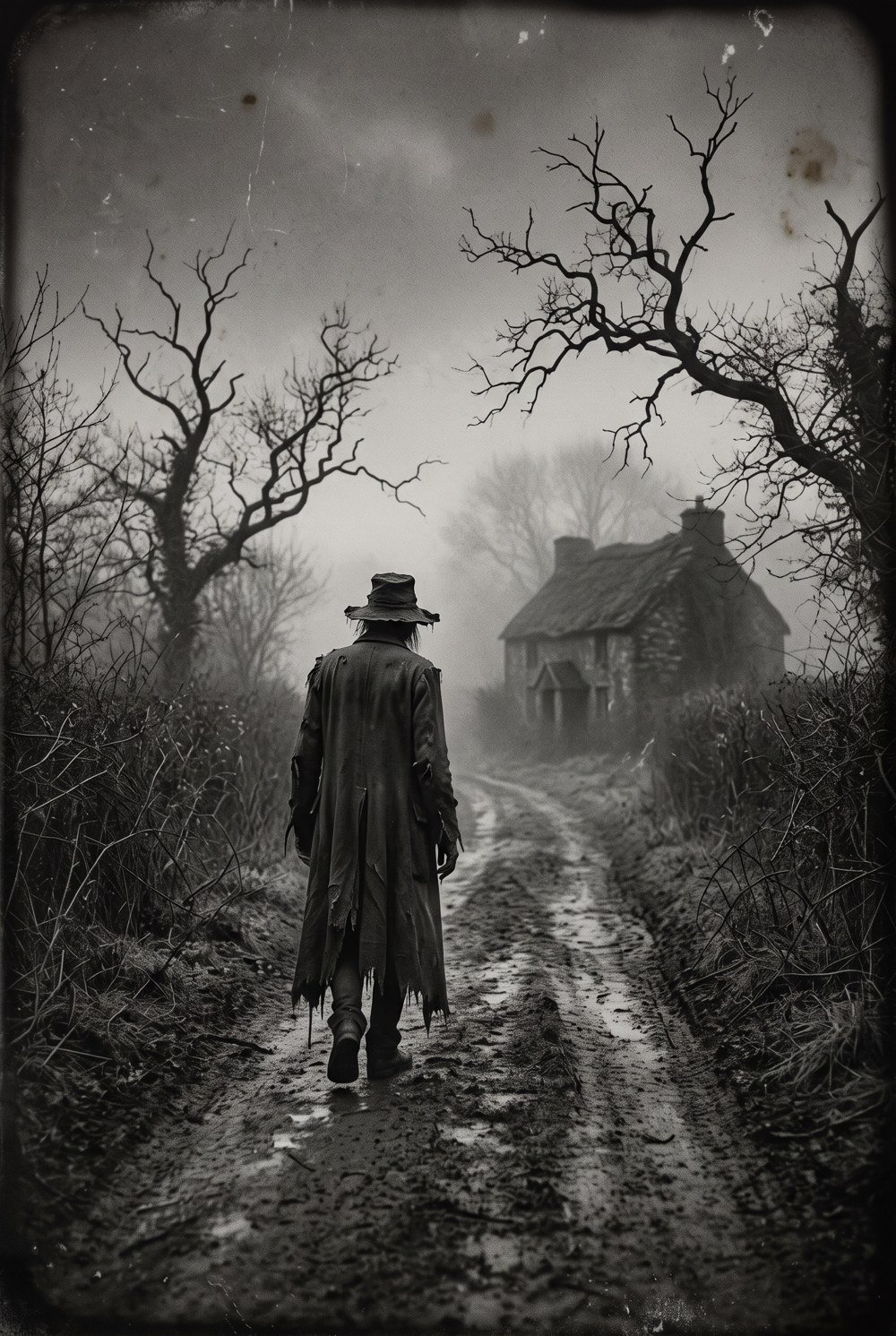
Aubrey had a particular sin eater in mind, one who lived in a cottage on the Ross highway. He described him, with the warmth for which antiquaries are not known, as “a long, leane, ugly, lamentable poor raskal”.
This was the job’s main problem. Neighbours who hired a sin eater for a funeral did not much want to see him on any other day. He had, after all, a great many other people’s sins inside him, and nobody could say for certain which ones. The work went to the very poor, because nobody else would take it, which is how a great many trades have filled their vacancies.
Aubrey, ever the scholar, thought the custom was very old. He said it “alludes, methinks, something to the scapegoate in the old lawe”, meaning Leviticus 16, where the sins of the people are laid on a goat that is sent out into the wilderness. The sin eater was the goat, except he lived down the road and could be paid in beer. He added that he believed the custom had once been “used all over Wales”.
The Church was not consulted
None of this was in the prayer book. The sin eater offered, for sixpence, roughly what the clergy offered for a lifetime of attendance, and he did it in an afternoon. The antiquary John Bagford, writing in 1715 about villages in Shropshire next to Wales, said the sin eater was paid a groat, ate a crust of bread and drank a bowl of ale “at a draught”, and promised the soul’s rest, “for which he would pawn his own Soul”.
Bagford asked how anyone could think it came from anywhere but “the ancient heathens”. Church authorities, it is generally reported, frowned on the whole business. The historian notes that their objection was theological, and not at all about anyone undercutting them on price.
A plate of salt on the chest

The custom left one more report. In 1852, at a meeting of the Cambrian Archaeological Association in Ludlow, a Swansea gentleman named Matthew Moggridge described sin eating near Llandybie, in Carmarthenshire. There, he said, the family “placed a plate of salt on the breast of the defunct, and upon the salt a piece of bread”. The sin eater ate the bread off the body and “received his fee of 2s. 6d.”
Two shillings and sixpence. In under two centuries, the price of carrying a stranger’s sins had gone up fivefold. Inflation spares nobody, not even the damned.
Did it really happen
Here the historian must be honest. The evidence is thin: Aubrey, Bagford quoting Aubrey, Moggridge, and a lot of later writers quoting all three. When the Folk-Lore Society argued about sin eaters in 1892, scholars could not even agree what the custom meant, and some doubted it had been as common as the antiquaries liked to think. Bread and drink at funerals were common everywhere. A man paid specifically to eat sins is much rarer in the record.
Still, the idea would not die. The novelist Mary Webb put a sin eating at the heart of Precious Bane in 1924, where a son takes on his dead father’s sins to claim the farm.
The last sin eater
In the churchyard at Ratlinghope, in the Shropshire hills, lies Richard Munslow, who died in 1906 and is remembered locally as the last sin eater in England. He was not a poor raskal at all, but a farmer from an established family. By 2010 his grave had fallen into ruin, so local campaigners raised about a thousand pounds to restore it, and the church held a special service to mark it.
A century earlier, the parish would have crossed the road to avoid him. Now it held a service in his honour. Sins, it seems, look very different once the man carrying them has been dead long enough.
The File
The documented record behind this post:
- John Aubrey, Remaines of Gentilisme and Judaisme (manuscript 1686 to 1687, published by the Folk-Lore Society 1881): Herefordshire funerals, bread over the corpse, “a mazar bowle, of maple, full of beer”, “sixpence in money”, the sin eater on the Ross highway described as “a long, leane, ugly, lamentable poor raskal”, the scapegoat of Leviticus 16:21 to 22, “used all over Wales”. (Ellis’s 1849 edition of Brand’s Popular Antiquities, transcribed at the Sin-Eater Resources archive, sineater.montystoryteller.org)
- John Bagford, letter of 1 February 1714/15, printed in Hearne’s edition of Leland’s Collectanea: Shropshire villages next to Wales, a groat, a crust of bread, a bowl of ale, “for which he would pawn his own Soul”, “the ancient heathens”. (same archive)
- Matthew Moggridge of Swansea, Cambrian Archaeological Association meeting at Ludlow, 1852: Llandybie, the plate of salt with bread on the breast, the fee of 2s. 6d. (Archaeologia Cambrensis, 1852, quoted by E. S. Hartland in Folklore, vol. 3, 1892; same archive)
- The 1892 to 1893 Folklore debate over Hartland’s paper “The Sin-Eater”, with objections from other scholars. (Folklore, vols. 3 and 4; same archive)
- Mary Webb, Precious Bane, 1924: the sin eating at the father’s funeral. (the novel)
- Richard Munslow, buried at Ratlinghope in 1906; about £1,000 raised to restore his grave; special service in the churchyard, 2010; the custom “frowned upon by the church”. (BBC News, September 2010, via History News Network)
Everything above the jokes is the record. The jokes are the historian’s.
Sign the Book. Odd histories, strange finds, first word on what comes next. Sign it at cocinadebrujas.com.