
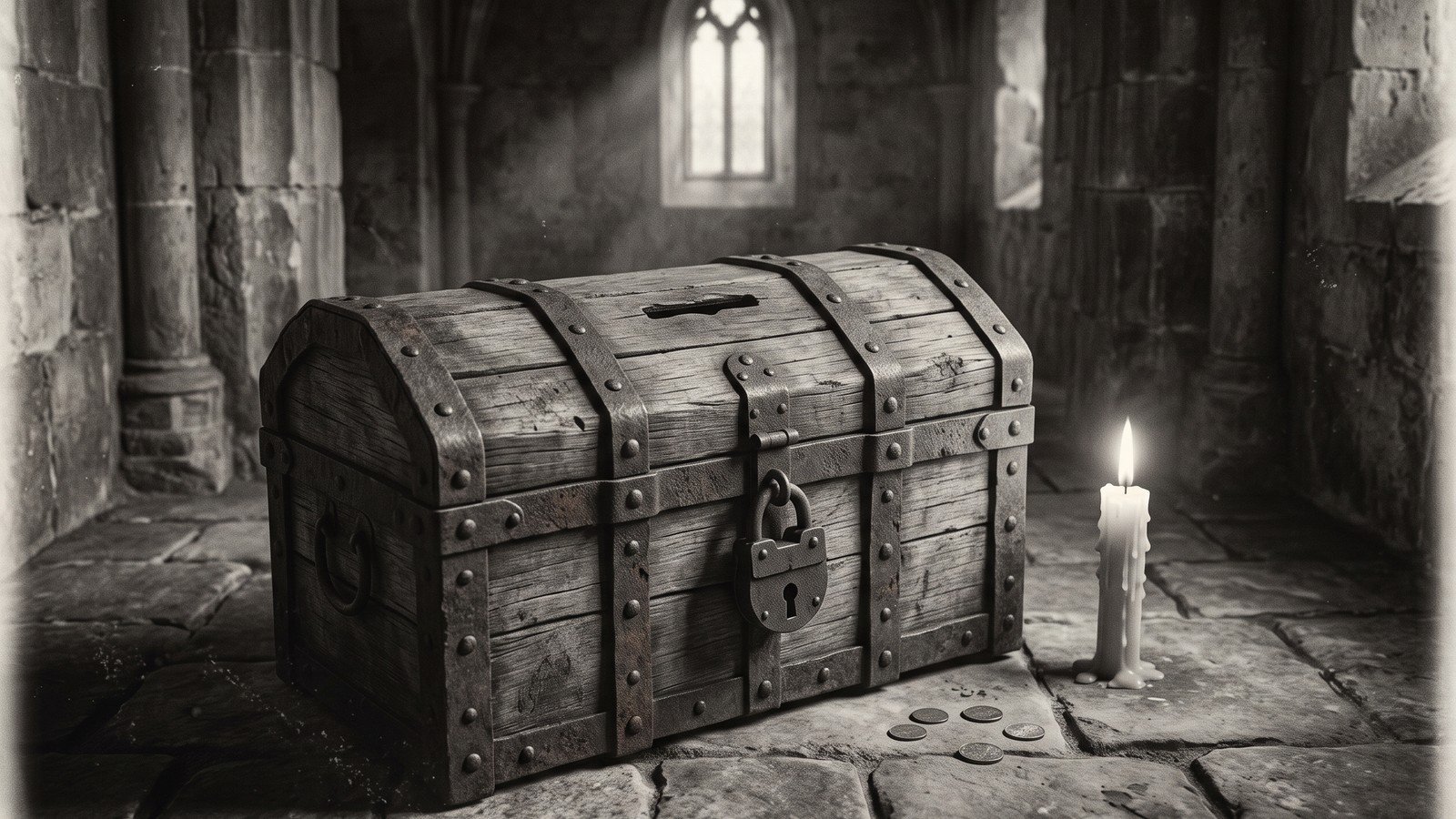
In the church of St. Nikolai in Jüterbog, a small town south of Berlin, there is a wooden chest bound in iron. It is old, heavy and very securely locked, which is what you would expect of a box that once held the price of other people’s souls.
It is said to be the money box of Johann Tetzel, the most famous salesman of the sixteenth century. His product was forgiveness. His territory was Germany. His customers, it turned out, included one very annoyed monk in Wittenberg.
The product
The Church taught that sins, even forgiven ones, left a debt of punishment, much of it to be paid off in purgatory after death. An indulgence reduced that debt. In principle it was granted for prayer, pilgrimage and good works. In practice, by the early 1500s, a generous gift of money counted as a very good work indeed.
On 31 March 1515, Pope Leo X proclaimed a plenary indulgence for the archbishoprics of Magdeburg and Mainz. The official purpose was splendid: the rebuilding of St. Peter’s Basilica in Rome.
The unofficial purpose was a bank loan.
The loan behind the forgiveness
The archbishop in question was Albrecht of Brandenburg. In 1513, at the age of 23, he became Archbishop of Magdeburg and administrator of Halberstadt. In 1514 he added Mainz as well. Church law said a man could not hold more than one bishopric. Rome said he could, for a fee.
Albrecht borrowed 20,000 guilders from the banker Jacob Fugger of Augsburg to pay the Roman Curia. Then came the arrangement. By a secret agreement, half the money from the new indulgence would go to the Fuggers, to clear the archbishop’s debts. The other half would go to the papal treasury for St. Peter’s.
So a peasant in Brandenburg who paid to shorten his grandmother’s time in purgatory was, in a strict accounting sense, paying off the archbishop’s mortgage on three bishoprics. Theology rarely gets this tidy.
The salesman

To do the actual selling, Albrecht hired Johann Tetzel, a Dominican friar born around 1465 in Pirna. Tetzel was an experienced preacher of indulgences, and in January 1517 he was made commissioner for the archbishop in Magdeburg and Halberstadt.
He is remembered for a couplet. In one common English version it runs: “As soon as the coin in the coffer rings, the soul from purgatory springs.” Historians point out that it was attributed to him and is almost certainly not a literal quotation. The historian notes that it did not need to be. It was the sort of line people believed he would say, which in marketing is the next best thing.
The man next door

Tetzel did not preach in Wittenberg. Luther later said in his table talk that Tetzel sold his letters at Jüterbog because he was not allowed to cross the border into the territory around Wittenberg. Jüterbog was a short walk away, and Wittenberg’s parishioners went.
Martin Luther, a professor of theology, was not impressed. On the eve of All Saints, 31 October 1517, he published ninety-five theses for debate. Two of them went straight for the box. Thesis 27: “They preach man who say that so soon as the penny jingles into the money-box, the soul flies out.” Thesis 28 added that when the penny jingles, “gain and avarice can be increased”, while the actual result was “in the power of God alone”.
Then he asked the question nobody in sales wants to hear. Thesis 86: “Why does not the pope, whose wealth is to-day greater than the riches of the richest, build just this one church of St. Peter with his own money, rather than with the money of poor believers?”
Neither Luther nor anyone else in Wittenberg knew about the Fugger deal at the time. He was objecting on principle. Principle, it turned out, was enough.
The knight and the future sin
The chest in Jüterbog comes with a story. The novelist Theodor Fontane, travelling through Brandenburg in the 1860s, recorded a local tale: a knight named Hans von Hake bought an indulgence for a sin he had not yet committed, then robbed Tetzel of the chest. The sin, presumably, was already paid for.
The historian must say plainly that this is folklore. It is also, as folklore goes, an excellent review of the product.
The end of the sale
Tetzel did not enjoy his fame. When the papal envoy Karl von Miltitz accused him of fraud and embezzlement, he withdrew to the Dominican house in Leipzig, worn out, and died there on 11 August 1519. Historians have since treated Miltitz’s charges with caution.
Luther, hearing Tetzel was dying, wrote to comfort him. He told him not to be troubled, “for the matter did not begin on his account, but the child had quite a different father.”
He was right. The salesman was gone. The banker, the archbishop and the basilica all did rather well.
The File
The documented record behind this post:
- The indulgence proclaimed by Leo X on 31 March 1515 for Magdeburg and Mainz; Albrecht as commissioner; the secret agreement sending half the proceeds to the Fuggers and half to the papal treasury for St. Peter’s; the theses published 31 October 1517; Luther unaware of the agreement. (Introduction to the 95 Theses, Works of Martin Luther, vol. 1, 1915, Wikisource)
- Theses 27, 28 and 86, quoted in the translation of Henry Eyster Jacobs and Adolph Spaeth, 1915. (Wikisource, “95 Theses”)
- Albrecht of Brandenburg: Archbishop of Magdeburg at 23 in 1513 and administrator of Halberstadt; Mainz from 1514; the rule against holding more than one bishopric; 20,000 guilders borrowed from Jacob Fugger for the fee to the Roman Curia. (Wikipedia, “Albert of Brandenburg”)
- Johann Tetzel: born about 1465 in Pirna; Dominican preacher; commissioner for Albrecht in Magdeburg and Halberstadt from January 1517; the couplet attributed to him but “almost certainly not a literal quotation”; Miltitz’s accusations; withdrawal to Leipzig and death on 11 August 1519; Luther’s letter of comfort. (Wikipedia, “Johann Tetzel”, citing Marshall 2009 and Smith 1913)
- The jingle in the “coin in the coffer” wording. (Randy Petersen, “Selling Forgiveness”, Christian History issue 14, 1987)
- The Tetzel chest in St. Nikolai, Jüterbog; Luther’s table talk on Tetzel selling at Jüterbog because he could not cross into Wittenberg; Fontane’s folk tale of Hans von Hake and the indulgence for a future sin. (Wikipedia, “St. Nikolai church (Jüterbog)”, citing Fontane, Wanderungen durch die Mark Brandenburg)
Everything above the jokes is the record. The jokes are the historian’s.
Sign the Book. Odd histories, strange finds, first word on what comes next. Sign it at cocinadebrujas.com.