
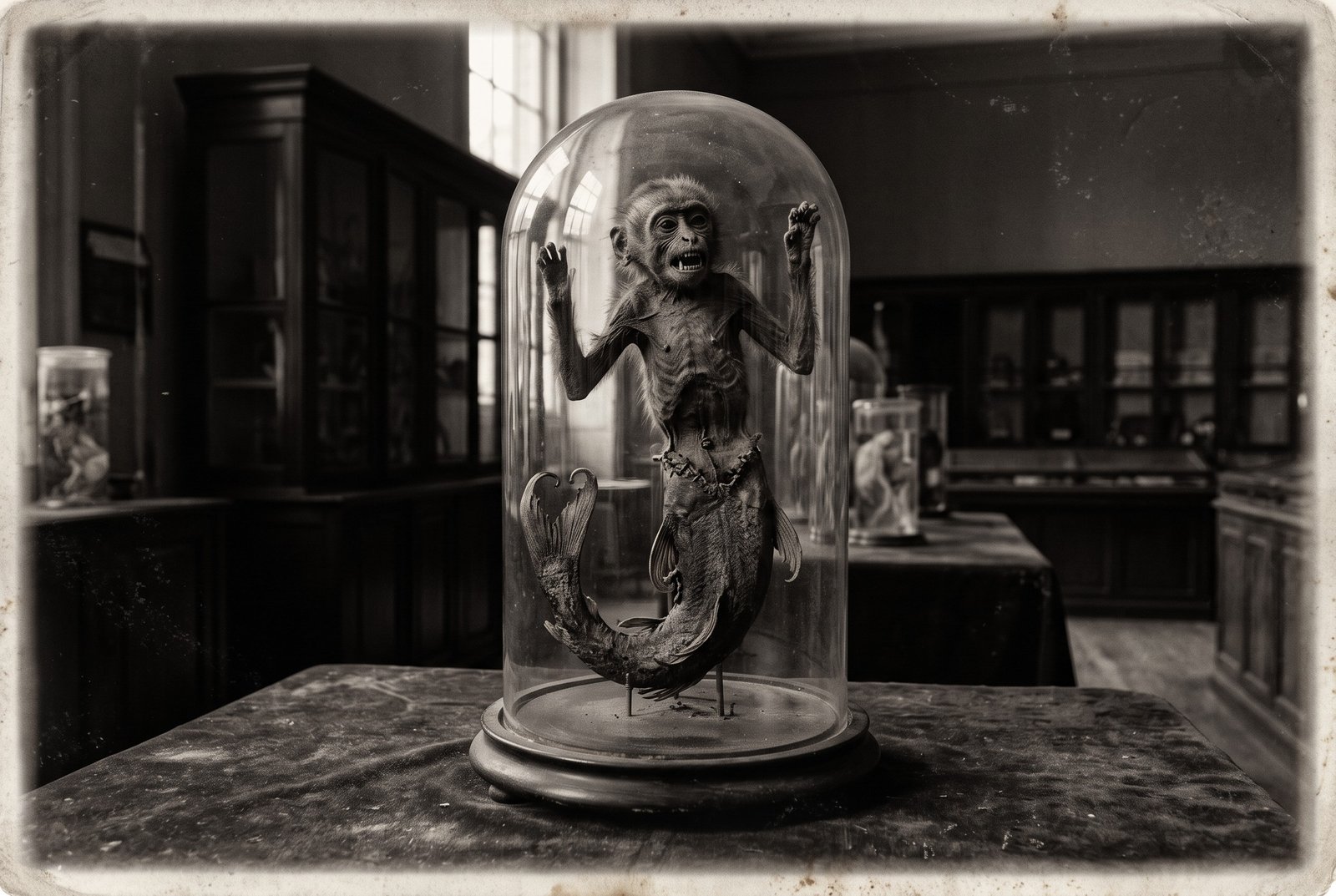
In the summer of 1842, New York was told that a mermaid had arrived in town. The Sunday papers printed her picture. She was young and long haired and very lovely.
The real one was small, black and dried, with her mouth open and her arms thrown up. The man who sold the tickets said she looked as if she had died “in great agony.”
This is the Feejee Mermaid. We know a great deal about how she was sold, because in 1855 the seller wrote it all down and published it.
A purchase on the company account
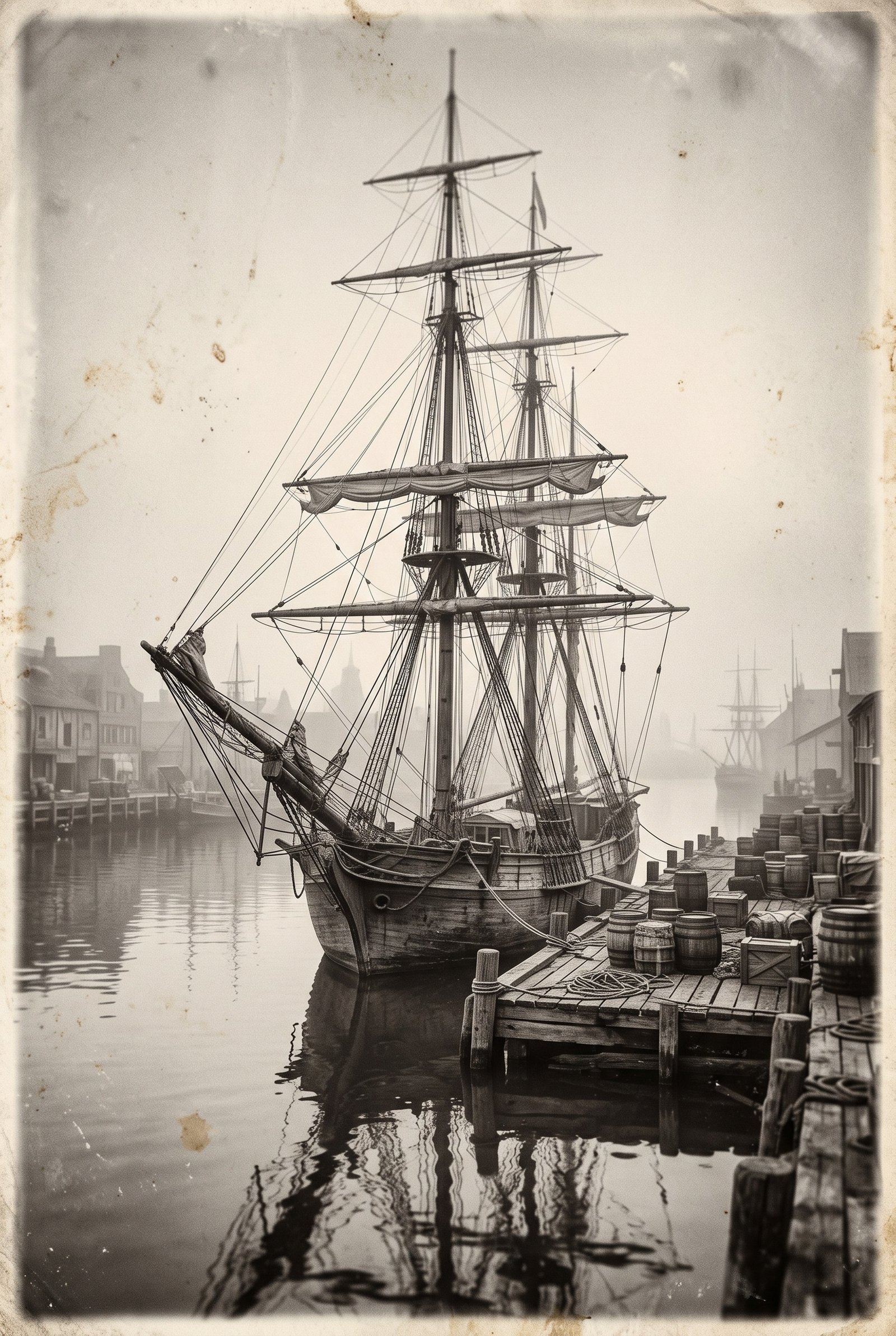
She began her Western career with a Boston sea captain, Samuel Barrett Eades. In an Eastern port, around 1822, he was shown a preserved mermaid and believed in her completely. Accounts disagree on the port. They agree on the money.
According to P.T. Barnum, the captain “appropriated $6000 of the ship’s money” to buy her, left the ship in charge of the mate, and went to London.
In the autumn of 1822 she was on show at the Turf Coffee House in St James’s Street. A satirical etching of the scene by Isaac Robert Cruikshank, dated October 24, 1822, is now in the Metropolitan Museum of Art. London came to look. London’s naturalists said she was a fake.
Eades did not get rich. Barnum says he went back to sea to pay off the debt and died owning nothing but the mermaid. His son, who “placed a low estimate on his father’s purchase,” sold her to Moses Kimball of the Boston Museum.
The historian notes that the son is the only person in this story who looked at the mermaid and saw what was actually there.
“Because I don’t believe in mermaids”
Early in the summer of 1842, Kimball brought her to New York to show Barnum. Barnum asked his naturalist for an opinion. The naturalist said he could not work out how she had been made. He had never known a monkey with such teeth, or a fish with such fins.
“Then why do you suppose it is manufactured?” Barnum asked.
“Because I don’t believe in mermaids,” said the naturalist.
“That is no reason at all,” said Barnum, “and therefore I’ll believe in the mermaid, and hire it.”
The doctor who did not exist
Letters began to appear in New York papers, posted from Montgomery, Charleston and Washington. Each mentioned a Dr. Griffin, agent of the Lyceum of Natural History in London, travelling with a mermaid caught near the Fejee Islands.
Barnum wrote all three letters himself and had friends post them on the right dates. Dr. Griffin was a man named Levi Lyman, who worked for Barnum.
Lyman showed the mermaid to editors in Philadelphia as a private favour, then took rooms at the Pacific Hotel in New York and let the reporters in.
Barnum, meanwhile, had three different mermaid pictures engraved. He took one to each of three newspapers and offered it free, as an exclusive. All three ran on Sunday, July 17, 1842. When the editors compared notes, Barnum recalled, “they pronounced it a scaly trick.” He also had boys sell 10,000 pamphlets proving that mermaids were real, at a penny each, half what they cost him.
The poorest show

On Monday, August 8, 1842, the mermaid opened at Concert Hall, 404 Broadway, for one week only, at 25 cents. Outside hung a painted picture of a beautiful creature, half woman and half fish, about eight feet long. Inside, under a glass vase, was what Barnum called “dried monkey and fish that a boy a few years old could easily run away with under his arm.”
An old man who had come over from New Jersey looked at her and announced, “Well, that is the poorest show I ever did see.”
While Lyman was out of the room, some medical students lifted the glass and put a half-smoked cigar in her mouth. Lyman came back, did not look down, and began his speech, which included the claim that she had lived “upwards of three hours” after her capture. A visitor asked whether her ladyship had been smoking the same cigar when she was caught.
When she moved to Barnum’s American Museum, Barnum hung out a flag showing her eighteen feet long. Lyman refused to work under it, pointing out that the public would not accept “our dried-up specimen eighteen inches long” after a picture eighteen feet. The flag came down.
The same book describes her elsewhere as “about three feet long.” The people who owned her could not agree on her size, which is the one thing she truly had in common with a fish.
What she was, and where she went
Barnum thought she was the work of a Japanese craftsman. He quoted an account, based on the German writer Philipp Franz von Siebold, of a Japanese fisherman who joined the top half of a monkey to the bottom half of a fish, said it had spoken a prophecy before it died, and did a brisk trade selling its picture as protection against disease. Barnum, with real professional admiration, gave that fisherman the title “Prince of Humbugs.”
She toured for years. Her end is not on record.
Harvard’s Peabody Museum has held a small mermaid since 1897, given by Kimball’s descendants. Whether it is the Feejee Mermaid herself, a curator there told the Harvard Crimson in 2016, is “unclear.”
The historian considers this the first completely honest statement anyone has made about her.
The File
The documented record behind this post:
- Kimball’s offer, the sea captain’s story and the $6000, the naturalist’s “Because I don’t believe in mermaids,” the three letters, Lyman as Dr. Griffin, the Philadelphia and Pacific Hotel showings, the three woodcuts of July 17, 1842, the 10,000 pamphlets at a penny, the Concert Hall advertisement (404 Broadway, August 8 to 13, 1842, 25 cents), the eight foot transparency, the New Jersey visitor, the cigar, the eighteen foot flag, “about three feet long” and “eighteen inches long,” the Siebold quotation and “Prince of Humbugs.” (P.T. Barnum, The Life of P.T. Barnum, Written by Himself, New York: Redfield, 1855, pages 230 to 241. Full scan: Internet Archive, item lifeofptbarnum00barnuoft)
- Captain Samuel Barrett Eades, about 1822, $6,000; London naturalists called it a fake; sold to Kimball by Eades’s son. (Alex Boese, Museum of Hoaxes, “The Feejee Mermaid,” hoaxes.org. Barnum’s 1855 book does not name the captain and gives Calcutta, 1817, so this post does not name a port.)
- The Turf Coffee House exhibition, St James’s Street, London: Isaac Robert Cruikshank, The Mermaid, Now Exhibiting at the Turf Coffee House, St. James’s Street, hand-colored etching, October 24, 1822. (Metropolitan Museum of Art, object 814373)
- The Peabody Museum mermaid, given by Kimball’s descendants in 1897; whether it is the original is “unclear” according to a Peabody curator. (The Harvard Crimson, “The Feejee Mermaid,” October 13, 2016)
Everything above the jokes is the record. The jokes are the historian’s.
Sign the Book. Odd histories, strange finds, first word on what comes next. Sign it at cocinadebrujas.com.